

MUTARE, Zimbabwe — The Southern Alliance for Indigenous Resources has won an environmental stewardship and social impact award for its work helping rural communities protect natural resources while generating income from conservation.
The Zimbabwean nonprofit, known as SAFIRE, received the Environmental Stewardship and Social Impact Award at the 2026 Manicaland Province CSR, ESG and Responsible Business Awards, held alongside the 10th Annual Zimbabwe ESG and Responsible Business Summit in Mutare.
The recognition comes as Zimbabwe moves to strengthen the role of local communities in conservation following changes to the country’s parks and wildlife legislation.
The Parks and Wildlife Amendment Act passed by Parliament earlier this year gives greater recognition to community participation in the management of natural resources and the benefits communities derive from conservation.
Community-based natural resource management has been practiced in Zimbabwe for decades, including through organizations such as SAFIRE, but its principles had not previously been explicitly recognized in the country’s parks and wildlife legislation.
SAFIRE Director Estella Toperesu said the award recognized both the organization and the communities involved in its conservation programs.
“This recognition is a proud milestone for SAFIRE and for the communities we have had the privilege to work alongside over the past three decades,” Toperesu said.
“It affirms our conviction that lasting conservation is achieved when local people are empowered to restore, manage and sustainably benefit from their natural resources.”
Founded in 1994 during humanitarian work at Tongogara Refugee Camp, SAFIRE now operates mainly in Manicaland, Masvingo and Matabeleland South provinces.
Its approach seeks to make conservation economically worthwhile for rural households by helping communities establish businesses based on natural resources while protecting the ecosystems on which those businesses depend.
Since 2014, SAFIRE has supported enterprises involving honey, baobab, mopane worms and marula. Communities are encouraged to process natural products into higher-value goods, including cosmetics and candles, rather than selling raw products.
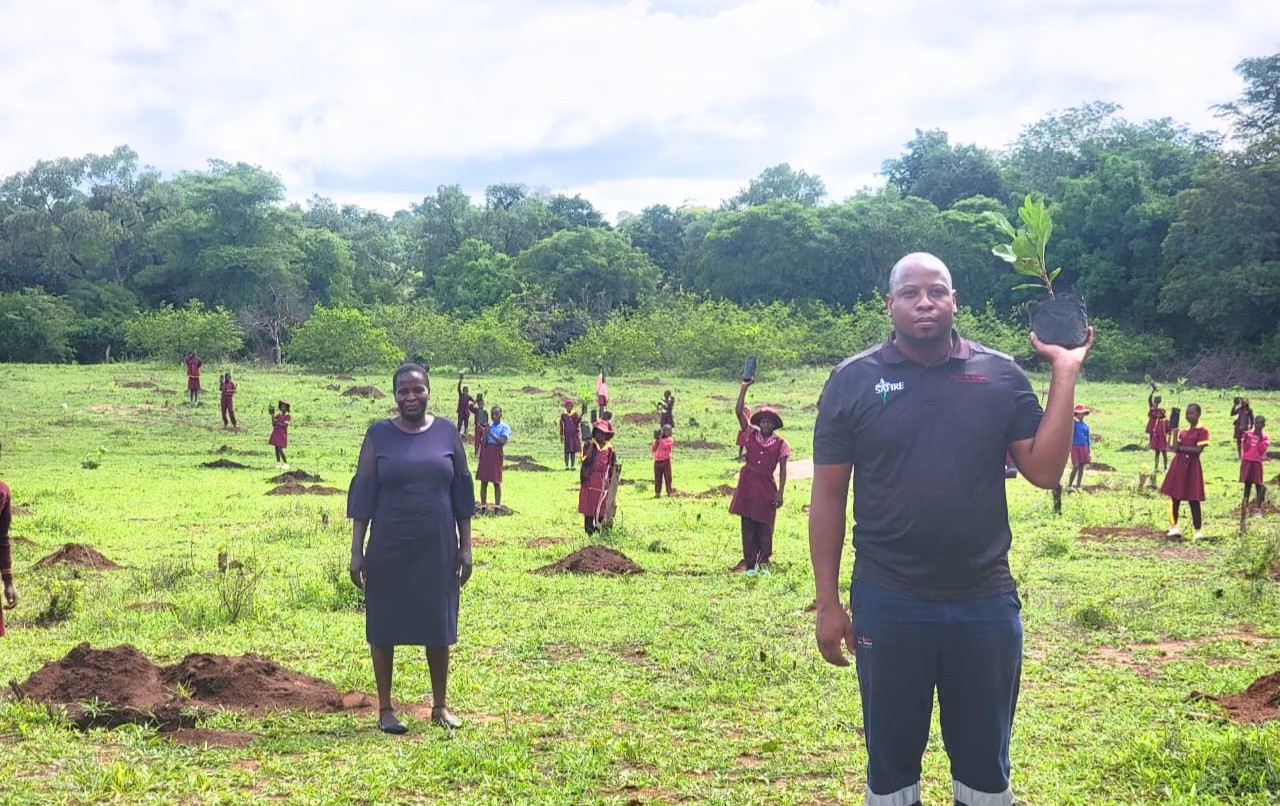
The organization also works on reforestation, wetland restoration, soil erosion control and sustainable land management.
SAFIRE says its programs have reached more than 33,000 households over the past decade and increased average monthly household income among beneficiaries by $165 through nature-based enterprises.
It says nearly 600,000 trees have been planted through its restoration work, while about 50,000 hectares of degraded land have been regenerated and 5,600 hectares of farming land protected.
The organization also distributes fuel-efficient “tsotso” stoves, which use less firewood than traditional cooking methods. SAFIRE says their introduction has helped reduce deforestation by 60% across nine districts.
Its work extends beyond environmental restoration to improving rural livelihoods.
SAFIRE operates village savings and lending associations that allow residents to finance farming and small businesses, rehabilitates irrigation schemes and establishes solar-powered water systems for community gardens.
In 2025, the organization solarized two community gardens that provided reliable water for 68 farming households and 1,280 livestock. It also restored 13 hectares of wetlands that SAFIRE says support water security for about 11,500 people.
The organization says a natural resource management model it pioneered at district level about two decades ago has since been adopted by all 60 of Zimbabwe’s rural district councils.
Toperesu said the award came at a time when Zimbabwe was placing greater emphasis on community-centered environmental management and sustainable development.
“We are grateful to our communities, partners and dedicated staff whose commitment has made this possible,” she said. “Looking ahead, we remain focused on scaling our impact, forging new partnerships and reaching more communities with solutions that protect ecosystems while improving lives.”
SAFIRE points to farmers such as Tawanda Bukuta in Mutasa District as an example of how conservation can be linked to household income.
According to the organization, Bukuta previously earned about $100 a month growing rain-fed maize on degraded land.
After joining SAFIRE’s forest restoration program three years ago, he established a nursery producing export-quality peach seedlings and now earns about $1,500 a month. He has since helped 60 other farmers establish an orchard and nursery group.
“I have learned the importance of protecting and nurturing our forests,” Bukuta said. “There is life in these ecosystems.”
SAFIRE’s work comes against a broader challenge facing Zimbabwe’s rural areas, where communities depend heavily on forests, land and water for their livelihoods while also experiencing the effects of deforestation, land degradation and increasingly severe droughts.
The organization argues that giving communities an economic stake in conservation can reduce pressure on natural resources while improving household resilience.
The awards were organized by the Environmental Social and Governance Network Zimbabwe and marked the organization’s 10th anniversary. This year’s event was held under the theme, “Driving Devolution, Empowering Communities towards Vision 2030: Celebrating Sustainability Excellence in Manicaland.”
