

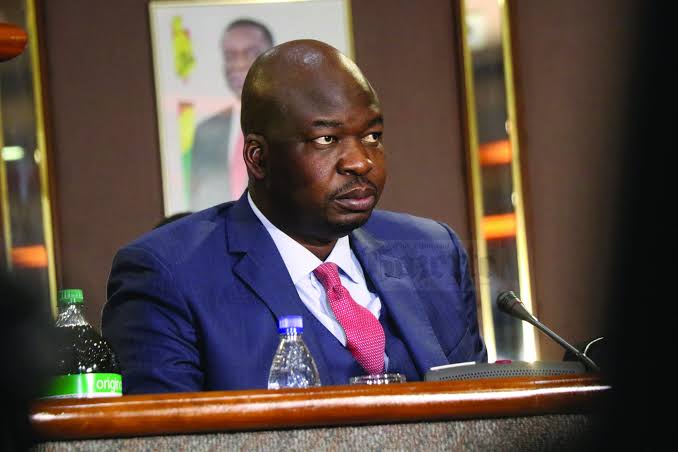
By Brighton Mugari
IN SEPTEMBER 2024, Finance secretary George Guvamatanga was in a spot of bother over an array of alleged offshore properties and other lavish assets.
Fast forward to this year, and the man finds himself in a similar predicament — although the sources and circumstances of the controversy are somewhat different.
While Guvamatanga came under intense scrutiny in 2024 over claims that he owned more than 12 affluent properties in South Africa, and amid wider political claims by the late Blessed Geza about a so-called clique of powerful non-state actors behind President Emmerson Mnangagwa’s throne, he has again found himself under fire following a Zimbabwe Revenue Authority (Zimra) compliance exercise at Borrowdale Brooke (BB).
The exercise has coincided with claims circulating on social media that Guvamatanga owns as many as 25 properties in the gated community — allegations for which no documentary evidence has publicly been produced.
“The BB homeowners association wishes to advise residents that Zimra has requested information relating to properties within the estate. The information (sought relates to) property owner, tenant’s name (if any), lease commencement date..,” read a leaked memo and notice that has been widely circulating on social media, adding the “request was being made in terms of section 39 of the Income Tax Act”.
“In terms of the said provision, the association is under a legal obligation to comply with the request. We, therefore, advise residents that (we are) working with Zimra and will be releasing the information shortly. No information beyond the statutory request shall be disclosed,” it said.
Some of Guvamatanga’s detractors have sought to link the Zimra exercise directly to the Treasury boss, while the rumour mill has gone into overdrive over claims that the former Barclays Bank chief executive owns 25 houses in the enclosure.
The claims have inevitably revived questions and debate around Guvamatanga’s wealth and property portfolio. But they have also highlighted the dangers of presenting unverified social media claims as established fact.
There is, at present, a significant difference between alleging that Guvamatanga owns 25 houses in Borrowdale Brooke and producing evidence demonstrating that he does.
If those making the claims genuinely possess credible information about the Victor Farm owner’s alleged property holdings, title deed numbers or other independently verifiable records would go considerably further in establishing their case than social media posts and anonymous assertions.
The purpose here is not to vouch for “Saint George’s” piety or probity. Public officials — particularly senior officials involved in managing the country’s finances — should expect scrutiny of their assets and conduct.
What is equally important, however, is that such scrutiny is grounded in evidence.
Guvamatanga is known to own properties, including in the plush northern Harare area, but the claim that he owns nearly 25 houses in Borrowdale Brooke has not, on the information publicly available, been substantiated.
As Guvamatanga himself told us at the height of the 2024 controversy, including allegations that he was in the habit of shaking down government contractors, he enjoyed a successful banking career that enabled him to acquire properties in Africa, Europe and other jurisdictions from as far back as 2003. He also said he had built a real estate business over the past 20 years and developed a productive farming enterprise.
There have also been claims that Guvamatanga declared about 40 properties when he joined government in 2018. Forward Madyira, a guest writer in one of Zimbabwe’s leading dailies, previously made that assertion.
If correct, such a declaration would be significant because it could help establish which assets Guvamatanga owned before entering public service. Ideally, however, claims about declarations by senior public officials should be backed by records that can be independently verified.
The same standard must apply to both sides.
Those alleging that Guvamatanga amassed unexplained wealth should produce evidence supporting their claims. Equally, assertions that all his assets were properly declared or acquired before he joined government should be capable of verification.
Guvamatanga and his lawyers have previously maintained that properties associated with him were acquired using “free funds from his Barclays plc days”. There is nothing inherently unlawful about a successful banker or businessman investing in property. The relevant questions are whether the assets were lawfully acquired, properly declared where required and consistent with applicable laws and regulations.
This distinction is often lost in Zimbabwe’s politically charged and polarised public discourse, where allegations can quickly harden into accepted “facts” long before documentary evidence has been produced.
That does not mean Guvamatanga should be insulated from criticism. His position at the centre of Treasury policy means his decisions affect millions of Zimbabweans, and robust scrutiny comes with the territory.
The latest controversy also comes against the backdrop of the government’s drive to increase tax collections.
Guvamatanga said in February that Zimbabwe was not overtaxed compared with regional trends and argued that the country’s tax-to-gross domestic product ratio, then around 17 percent, needed to rise towards 22 percent. The broader ambition is to push annual revenue beyond US$10 billion as part of efforts to move Zimbabwe towards middle-income status.
Those policies are bound to attract criticism, particularly from individuals and businesses facing greater scrutiny from the tax authorities.
But it would be equally problematic to assume, without evidence, that the Borrowdale Brooke exercise is Guvamatanga’s personal initiative or that criticism of him arising from it is necessarily retaliation for his tax policies.
Zimra itself says its information-gathering exercise is part of routine compliance checks rather than a campaign targeting wealthy individuals or residents of a particular area.
Guvamatanga has also been involved in economic policy at a time when Zimbabwe has recorded some developments welcomed by the government, including progress in its engagement with international financial institutions and creditors.
How much credit should be attributed to any single official is debatable. So too is the overall success of Zimbabwe’s economic policies, particularly when weighed against the experiences of ordinary citizens and businesses.
What is less debatable is that Guvamatanga remains one of the country’s most visible and consequently most scrutinised senior civil servants.
As long as he occupies that position and continues to champion consequential fiscal and tax policies, questions about his decisions — and his own financial affairs — are unlikely to disappear.
The answer should not be to shield him from scrutiny, nor should it be to treat every allegation circulated online as fact.
If Guvamatanga owns 25 properties in Borrowdale Brooke, those making the claim should produce credible evidence. If he does not, the allegation should not be repeated as established fact.
That is ultimately the standard that should apply to Guvamatanga, his critics and everyone else: scrutiny where warranted, evidence where allegations are made, and fairness in drawing conclusions.


