

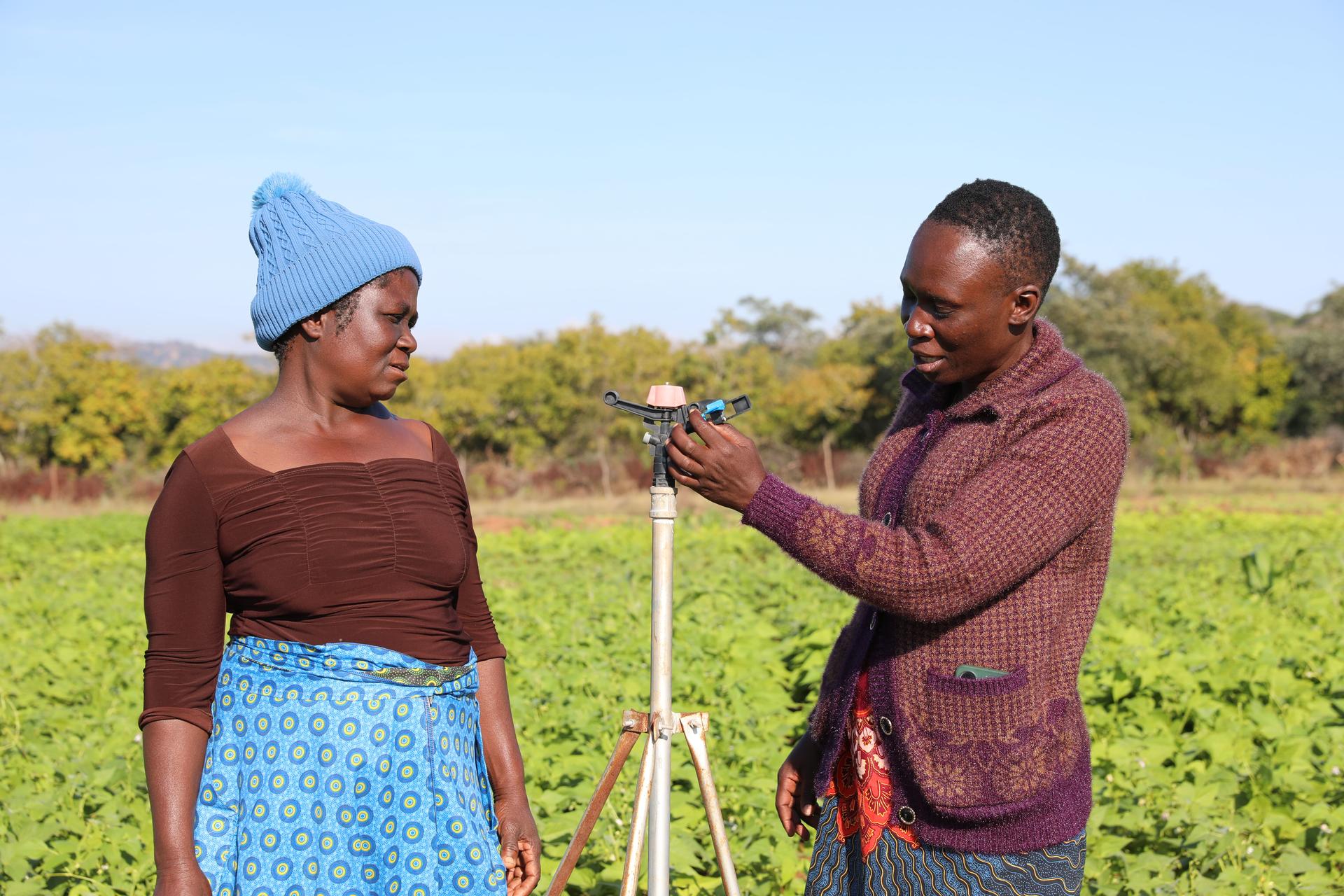
Chipinge – More than 200 farmers in Chipinge District are beginning a new chapter of year-round agricultural production following the revitalisation of the 27-hectare Farai Irrigation Scheme through the Green Climate Fund (GCF)-supported Climate Resilient Livelihoods Project.
Key highlights:
- The Government of Zimbabwe, with support from UNDP and financing from the Green Climate Fund, has revitalised Farai Irrigation Scheme to strengthen climate resilience and rural livelihoods.
- The 27-hectare scheme is benefiting 203 farmers, including 112 women, with reliable access to irrigation water.
- Farmers have planted 18 hectares of sugar beans, five hectares of wheat and two hectares of maize in the scheme’s first productive season following rehabilitation.
- Solar-powered pumping, improved water infrastructure and climate-smart agriculture are reducing farmers’ dependence on increasingly erratic rainfall.
- Farmer Field Schools are helping women, young people and other farmers develop practical skills to improve productivity and treat agriculture as a viable livelihood and business.
Implemented by the Government of Zimbabwe with support from the United Nations Development Programme (UNDP), the intervention has equipped the scheme with climate-resilient infrastructure, including a solar-powered pumping system, improved water abstraction facilities and a modern irrigation network.
The investment is enabling 203 farmers, including 112 women, to cultivate their land with greater confidence after years in which the scheme remained underutilised and farming families continued to depend heavily on increasingly unpredictable rainfall.
Established in 1995, Farai Irrigation Scheme was intended to provide reliable water for year-round agricultural production. However, incomplete infrastructure and governance challenges prevented the scheme from reaching its full potential.
Today, that is beginning to change.
In its first productive season following revitalisation, farmers have planted 18 hectares of sugar beans, five hectares of wheat and two hectares of maize. While they are still awaiting their first harvest, healthy crop stands are already demonstrating the potential of combining reliable irrigation with improved agricultural practices.
Alongside investment in infrastructure, the project is strengthening farmers’ knowledge through the Farmer Field School approach, which enables farmers to learn by observing, experimenting and comparing agricultural practices directly in their fields.
Working with Agricultural Extension Officer Lorraine Chimbadzwa, farmers regularly assess crop performance, test improved agronomic techniques and share lessons with one another.
“The Farmer Field School approach is changing the way farmers think,” said Lorraine. “Instead of simply telling them what works, they are seeing the results for themselves. When they compare crops side by side, they gain confidence in adopting improved farming practices because the evidence is right in front of them.”
The approach is helping farmers adopt climate-smart agriculture while strengthening local knowledge and problem-solving skills that can continue beyond the life of the project.
For Saliwe Khumbula, a 51-year-old mother of five, the transformation has brought renewed hope after decades of waiting for the scheme to realise its promise.
“When this irrigation scheme was established in 1995, we believed our lives were about to change,” she recalled. “But years passed and nothing happened. The infrastructure remained there, but we could not use it.”
Today, she is farming under very different conditions.
“Now everything is different. We have water, we are learning better farming methods, and we can plan our farming with confidence,” she said. “We are no longer farming just to survive; we are farming to improve our lives.”
The revitalised scheme is also changing perceptions of farming among younger community members.
For 22-year-old farmer Memory Maronga, reliable irrigation and practical agricultural training have demonstrated that farming can offer more than subsistence.
“Many young people think farming is too risky because it depends on rainfall,” she said. “Now we have reliable irrigation, and we are learning modern farming techniques. It has shown me that agriculture can become a real business.”
Women are also at the forefront of Farai’s revival. Of the scheme’s 203 beneficiaries, 112 are women, many of whom are actively participating in production, decision-making and management.
The revitalisation of Farai Irrigation Scheme demonstrates how partnership, climate-resilient infrastructure, practical agricultural knowledge and strong community participation can work together to strengthen food security, improve livelihoods and help farming communities adapt to a changing climate.
For farmers such as Saliwe and Memory, Farai is no longer defined by unrealised potential. With reliable water now reaching their fields, the scheme represents a new beginning — and the prospect of more productive, resilient and secure livelihoods for farming families.

