

HWANGE – Slow ranger reaction times and deployment to hotspots for poaching and human-wildlife conflict have been one of the major barriers to preventing poaching and establishing sound relationships with communities in Zimbabwe’s largest national reserve.
A new ranger station launched on Saturday has set the park on a positive conservation trajectory, away from its past misfortunes, the biggest being when 300 elephants and other animals in the western part of Zimbabwe’s Hwange National Park were poisoned with cyanide in 2013.
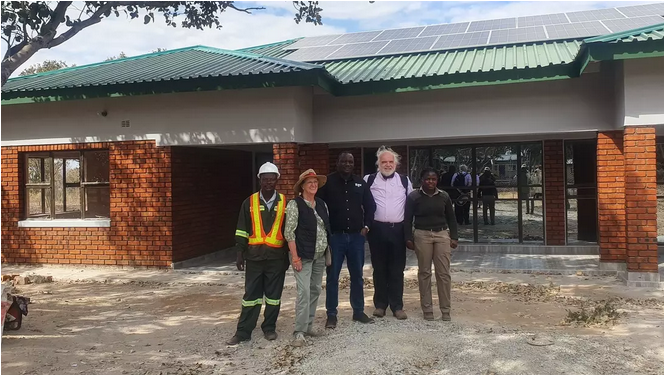
Makona is now a fully-fledged permanent ranger base covering over 5,000 km2 southern section of Hwange National Park which shares a long and open boundary with both community lands and neighbouring Botswana.
From only two small building blocks which were scarcely resourced, the camp now includes an office complex, operations centre, recreational facility, an enhanced radio communications system and 12 housing units accommodating 56 rangers and their families.
Before the camp was constructed, responses to poaching incidents and problem animals were slow, with rangers being deployed from Hwange Main Camp, some 95 kilometers away and enduring a terrible road snaking through the sticky Kalahari sands.
Zimbabwe Parks and Wildlife Authority director Fulton Mangwanya said the ranger base, constructed at a cost of US$500,000 was a milestone project of the five-year conservation agreement between International Fund for Animal Welfare (IFAW) and Zimbabwe Parks and Wildlife Authority (ZimParks) and puts rangers at the centre of what was once a wildlife poaching hotspot.
“Although this construction project was characterised by several whoops and hardships, the noticeable dedication, commitment and collaboration spirit of the personnel at different development levels which were supplemented by continuous financial support rendered by our highly esteemed wildlife partners in conservation, the IFAW have enabled us to collectively achieve this milestone,” he said.
Mangwanya added that the impact of all these investments has been significant, resulting in zero incidents of elephant poaching in IFAW-supported areas including Makona over the last three years.
The IFAW-ZimParks partnership is also investing in the development of sustainable tourism, providing key upgrades to campsites and lodges, and improving park visibility and viability through the construction of a new multi-purpose entrance gate and ancillary facilities.
The Makona base is situated approximately 15 kilometers from the Tsholotshlo community, which enables rangers to swiftly deploy to respond to incidents of human-wildlife conflict.
Azzedine Downes, IFAW President, and CEO said IFAW was thrilled to celebrate this achievement together with ZimParks.
“It is a testament to a mutual, long-term commitment to protecting and preserving biodiversity, grounded in a partnership to deliver transformational change for people, wildlife, and the natural environment,” Downes said.
Speaking at the launch on Saturday, Deputy Minister of Environment, Climate, Tourism and Hospitality Industry, Barbara Rwodzi encouraged communities to jealously conserve wildlife and work hand in glove with rangers.
Hwange National Park is home to 150 species of mammals and designated as an important bird area with 400 distinct species and a population of elephants that is estimated to be around 45,000 individuals.
It is also a core part of the Kavango Zambezi Transfrontier Conservation Area (KAZA TFCA). The establishment of the ranger base brings the partnership one major step closer to achieving its core mission: to protect the rich biodiversity of the area, conserve and enhance ecological processes, and secure key critical habitats while providing solutions that enhance ranger welfare holistically across an area spanning 14,651km2 acres.
To date, the IFAW-ZimParks partnership has invested more than US$3,5 million in the Hwange-Matetsi- Zambezi landscape. These funds have gone towards combatting wildlife crime, ranger welfare, park management (improving infrastructure; game water management), tourism development, wildlife rescue, and mitigating human-wildlife conflict.


