

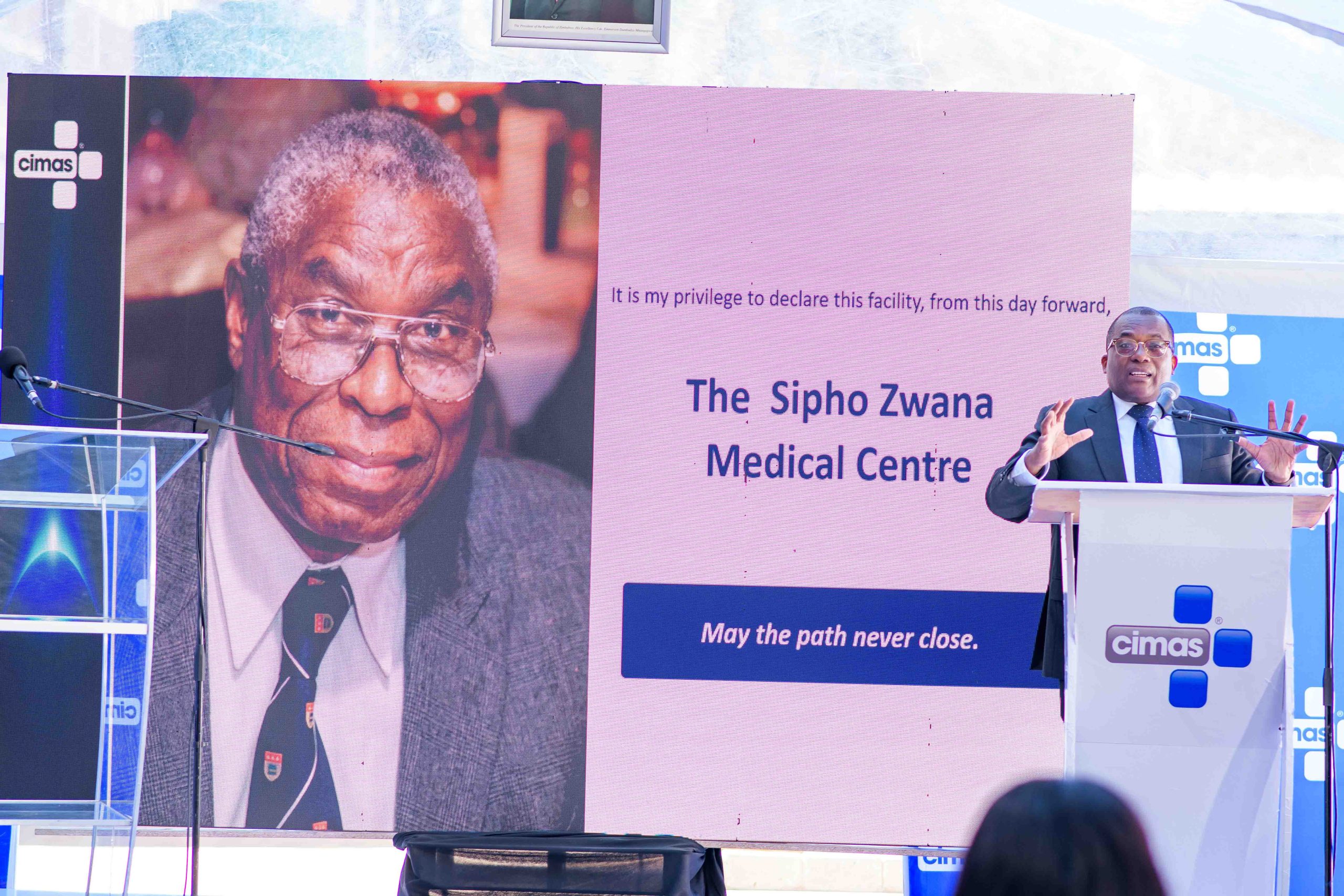
BULAWAYO — Cimas Health Group has renamed its Bulawayo Medical Centre after Dr. Sipho Leonard Vivian Zwana, a pioneering physician who became the first Black doctor to serve at Mpilo Hospital and Zimbabwe’s first Black anaesthetist.
The facility was formally renamed the Sipho Zwana Medical Centre at a ceremony in Bulawayo on Aug. 19, honouring a career spanning 52 years in Zimbabwe and abroad.
Cimas Health Group CEO Vulindlela Ndlovu said the renaming was intended to permanently preserve Zwana’s contribution to medicine.
“A naming is not a reward; he is far beyond rewarding. A naming is not sentiment; sentiment fades by Christmas. A naming is infrastructure for memory,” Ndlovu said.
“It is the deliberate act of placing a story where it cannot be quietly lost — into brick, into signage, into a referral letter, into the way a mother in Nkulumane tells her daughter where to go.”
Bulawayo Provincial Affairs and Devolution Minister Judith Mkwanda Ncube said Zwana’s legacy should challenge future generations of health professionals.
“Today, we are saying that the contribution of those who built Zimbabwe’s health system must not fade with time. We affirm that excellence deserves to be remembered,” Ncube said.
“And, perhaps most importantly, we are saying that a good legacy should not simply be admired. It must challenge the next generation to do even better.”
Zwana was born March 19, 1933, at Tekwane Mission to Methodist minister Rev. Solomon Zwana and Maria Zwana.
He was among eight Africans awarded government bursaries for medical training in 1954, according to Ndlovu. The group included Samuel Parirenyatwa, who became Zimbabwe’s first trained Black physician and after whom Parirenyatwa Group of Hospitals is named, and Herbert Ushewokunze, who later became health minister.
Zwana graduated with an MBChB from the University of Natal Medical School in South Africa in 1960, becoming the first Ndebele to qualify as a medical doctor, according to Ndlovu.
In 1961, he became the first Black doctor permitted to work at Mpilo Central Hospital, and in 1970 obtained a Fellowship of the Royal College of Surgeons, becoming the first Black Zimbabwean anaesthetist.
Ncube said Zwana later served as medical superintendent of Parirenyatwa Hospital and United Bulawayo Hospitals.
“Dr Zwana’s generation faced barriers that many of us today may struggle to fully appreciate. Yet he chose to enter a profession that was demanding, specialised and, at the time, not easily accessible to black Zimbabweans,” Ncube said.
“He did not merely enter the profession. He excelled. He served. That is the lesson we must carry forward.”
Zwana’s career took him to the United Kingdom, Ghana and Kenya. Ndlovu said he spent seven years at Korle Bu in Accra, where he practised and taught, before working at Kenyatta Hospital in Nairobi.
He returned to Zimbabwe in 1981 and later worked at Mater Dei Hospital in Bulawayo from 1987 until his retirement in December 2013.
Ndlovu said Zwana’s decision to specialise in anaesthesia reflected a career centred on service rather than recognition.
“The anaesthetist stands at the head of the bed, in the dark, holding a stranger’s life at the exact point between too much and too little, for hours, and when it is over the patient opens their eyes and thanks somebody else,” Ndlovu said.
“He was the man who watched while you slept.”
Zwana died Feb. 16, 2019.
Ncube said the renaming also highlighted the role private health providers such as Cimas play alongside the government as Zimbabwe faces increasingly complex health needs.
“This partnership between the public and private sectors is critical because the health needs of our population are growing and becoming more complex,” she said.
“As the Government we therefore welcome initiatives that strengthen quality, expand access, encourage innovation and improve the standards of healthcare available to Zimbabweans.”
Cimas, established in 1945, is marking its 80th year and has expanded beyond medical aid into clinics, laboratories, pharmacies and wellness services.
Ncube said Zwana’s name should serve as both recognition of the past and a challenge to those working in health care today.
“Let the Sipho Zwana Medical Centre be both a monument to a pioneer, and a mandate for us to do more,” she said. “That is how we truly honour 52 years of service. That is how we build the next 100 years of healing.”
Ndlovu formally declared the facility renamed, thanking Zwana’s family for allowing the institution to carry his name.
“To the Zwana family, thank you. Thank you for lending him to this city for a lifetime, and for lending him to us now, for as long as this institution endures,” he said.
