

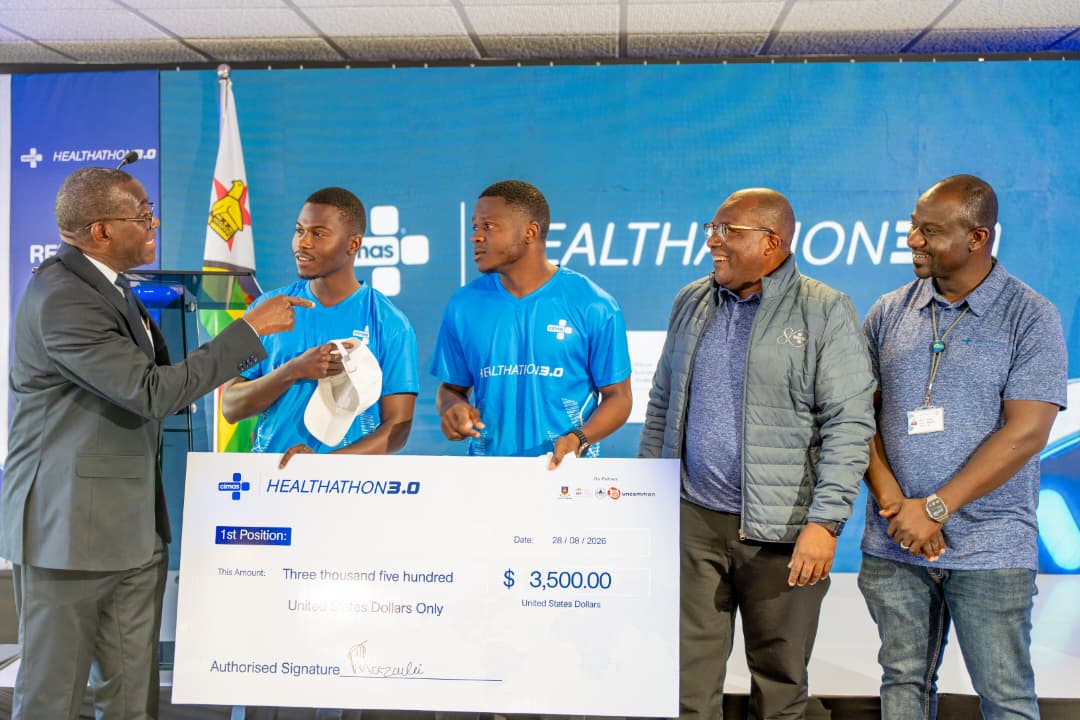
HARARE — A digital platform designed to help screen artisanal miners for silicosis has won the Cimas Healthathon 3.0, beating 371 other entries in a competition showcasing homegrown solutions to some of Zimbabwe’s healthcare challenges.
SilicaGuard took first place at the innovation challenge held at Cimas Health Group’s Borrowdale offices in Harare on Friday, followed by Runtime Terrors in second place and Blood Geo Alert in third.
The winners received US$3,500, US$2,000 and US$1,500, respectively.
SilicaGuard is a USSD and artificial intelligence-assisted lung health screening system designed with artisanal miners and low-connectivity communities in mind.
The platform assesses users’ lung-health risk, supports referrals and can track whether people referred for further examination reach a health facility. Its USSD component means miners can access the service using basic mobile phones without requiring smartphones or internet connectivity.
Silicosis is an incurable occupational lung disease caused by inhaling silica dust and is a particular concern among people working in mining and quarrying.
Health and Child Care Minister Douglas Mombeshora said innovation should be judged not by the sophistication of the technology involved but by whether it improves healthcare outcomes, according to a speech delivered on his behalf by Chief Director for Public Health Dr. Celestino Dhege, who represented him at the grand finale.
“The measure of any innovation is simple: does it improve a patient’s experience, reduce the cost of care, help a health worker do their job better, or reach someone who has been left behind?” Mombeshora said in the speech.
He urged innovators to develop solutions that can reach rural communities, low-income households, older people and people with disabilities.
“As we celebrate innovation today, I urge our innovators to design for the many, not the few,” the speech said. “Equity must be the heart of every solution.”
Mombeshora also called for improved relations between healthcare providers and medical aid societies, saying patients were bearing the consequences of disputes over tariffs, co-payments and delayed settlements.
“Doctors and medical aids are not adversaries. You are partners serving the very same patient,” he said in the speech.
“When providers and funders are at odds, it is not they who suffer most; it is the patient, caught in the middle and asked to pay the difference,” he said.
Mombeshora also invited private healthcare providers, medical aid societies, actuaries, academics and technology companies to participate in developing Zimbabwe’s proposed National Health Insurance scheme.
“The NHI is central to our journey towards Universal Health Coverage,” Mombeshora said in the speech. “But a reform of this magnitude cannot be designed in isolation.”
The Healthathon attracted 372 submissions from innovators, start-ups, researchers, students and technology enthusiasts across Zimbabwe before the field was narrowed to 10 finalists.
The finalists presented ideas addressing women’s health, blood shortages, cervical cancer screening, patient data protection, rehabilitation, occupational lung disease and healthcare delivery in communities with limited infrastructure.
Third-placed Blood Geo Alert proposed a geofenced SMS platform that could alert verified eligible blood donors near an open blood collection point when a hospital reports an urgent shortage.
Other innovations included an offline smartphone-based cervical cancer screening support tool developed by Peterhouse students, a solar-powered medical backpack for remote communities and a sensor-equipped rehabilitation glove designed to generate movement data for clinicians.
Mombeshora said in the speech that the real measure of the Healthathon would be whether ideas emerging from the competition eventually reach patients.
“The greater opportunity is what comes after today, when a promising idea is validated, incubated, partnered and piloted into the real world,” he said. “That is where an innovation earns its worth.”
Cimas has said promising projects could be considered for validation, incubation, partnerships or pilot programmes.
The other finalists, in order of their final ranking, were The Interns, Mambokadzi, Girls Who Code, Lango, Chengetai Health, Grip Co and Team Viva.

