

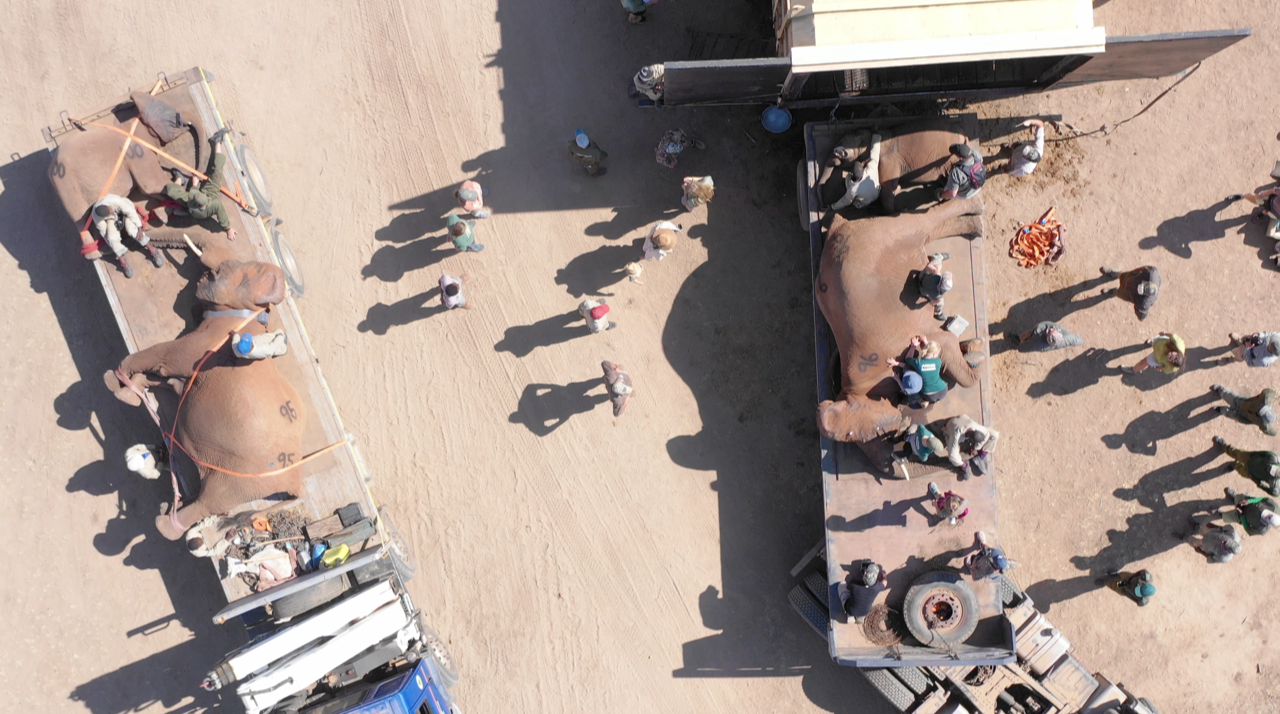
So far 101 African elephants had been translocated from the southern part of the country to Sapi, Zambezi Valley, in the north of Zimbabwe – a 700 kilometer journey but the future of the project now hangs in the balance over irreconcilable differences.
Stakeholders had hoped the mass translocation would set a standard across Africa for the movement of large quantities of wildlife from areas of overpopulation to areas of low density.
An ambitious project to move 2,600 wild animals from a southern reserve in Zimbabwe to one in the country’s north has gone up in smoke following a dramatic fall out of the parties involved.
The suppliers of the animals – the Savé Valley Conservancy and Sango Conservancy – accuse the project funder, Great Plains Foundation, of acting in bad faith.
They allege that the project funder created a false narrative that portrayed the translocation as being a result of climate change and drought within the southern reserve which was in variance with facts on the ground.
“Great Plains Foundation and its staff have made numerous recent public statements that are misleading, factually incorrect, and damaging to the reputation of Savé Valley Conservancy (SVC) and Sango Wildlife Conservancy (Sango),” said Wilfried Pabst, founder Sango Wildlife Conservancy.
Pabst argued that the alleged misinformation and other misleading statements from the funders of the project, which have been republished by various media, had damaged the two conservancies’ credibility and reputation.
Pabst added that a Memorandum of Understanding (MOU) which was agreed by the three parties as the basis for this translocation, planned over a two year period, had not been adhered to.
“In 2022, the Savé Valley Conservancy and the Sango Wildlife Conservancy entered into a partnership with the Great Plains Foundation under which they committed to donate wildlife at no cost to the Rewild Zambezi project,” Pabst said.
“In the MOU, Great Plains Foundation and all pledged to coordinate public outreach efforts with its partners and not to discredit its partners‘ reputations in any way. This pledge was not honored by the Great Plains Foundation.”
“The SVC and Sango repeatedly attempted to get the Great Plains Foundation to honor this agreement and to engage in factual, truthful reporting. Great Plains Foundation rejected these interventions and continued to make misleading statements.
“Among others and as an example, the following inaccurate statements were disseminated: „’…animals will die if they are not relocated,’ ‘animals would be culled if they are not relocated’ It costs US$10,000 to relocate each elephant…’ ‘…to save 400 elephants from drought…’ ‘…Climate change has made food and water scarce in the Save…’ ‘…Kill them or relocate them…’ and more.”
Savé Valley Conservancy CEO Harry Idensohn weighed in saying they had been left stunned by the alleged misleading reports.
“Whilst we acknowledge that we have excess numbers of animals in certain key species, particularly elephant, the reason for this excess has nothing to do with drought or climate change, though it is acknowledged that we are not immune to droughts or the effects of climate change, they are not the reason as to why we have an abundance of animals that we would be willing to translocate to areas requiring restocking,” he said.
“Furthermore, we as the SVC, subscribe to National Policies, such as Zimbabwe’s Elephant Management Plan and believe that it is crucial that any translocation destination party should fully adhere to such policy documents as well as engage with and seek agreement with the relevant conservation and community stakeholders in the recipient area so as to ensure that both conservation and community objectives are attained for the greater good of Zimbabwe, its wildlife, and people.”
The headquarters of the relocation was based in Sango Wildlife Conservancy, a 60,000 hectare area in the Savé Valley Conservancy.
So far 101 African elephants, in groups of six to eight, had been translocated from the Savé Valley Conservancy to Sapi, Zambezi Valley, in the north of Zimbabwe – a 700 kilometre journey.
The 101 were meant to be part of 400 elephants being translocated by Project Rewild Zambezi, through Great Plains Foundation.
The relocation project had begun in June this year and was set to run for two years.
It is not clear what will become of the Great Plains Foundations previously stated mission to facilitate anti-poaching training to secure the area where the animals were set to be moved.
Dereck Joubert – CEO of Great Plains Conservation had previously told Zim Morning Post the translocated elephants have been adapting well to their new environment.
Reached for comment regarding the accusations and pulling out of two other parties in the agreement, Great Plains Foundation said they could not give a comment at this juncture.
Away from the internal conflict, the project had faced external opposition from wildlife researcher Dr David Cumming and Richard Maasdorp, strategic director of the Zambezi Society.
Critics of the mass translocation opined that the drivers of any declining populations have not be have not been fully investigated.

